
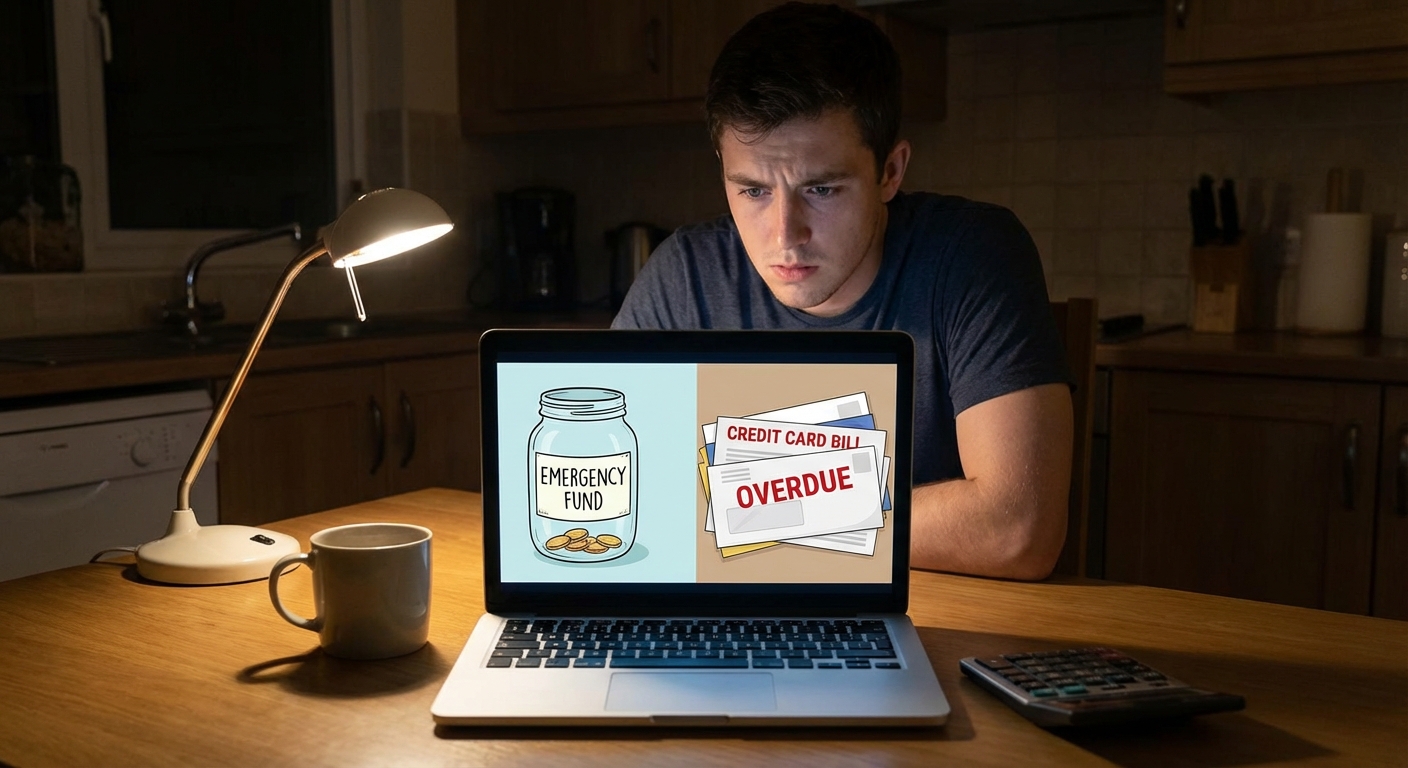
If you’re just starting your money journey, you might feel stuck between two important goals:
The Common Dilemma: Save or Pay Off Debt?
- Building savings so you’re not one surprise bill away from panic
- Paying down debt, especially high-interest debt like credit cards
You may wonder: Should I save first? Attack debt first? Try to do both?
The answer depends on your situation, but there is a simple, beginner-friendly way to approach this without guesswork or guilt.
Step 1: Understand What an Emergency Fund Actually Is
An emergency fund is money set aside for unexpected, urgent expenses, such as:
- Car repairs you need to get to work
- Medical or dental bills
- Job loss or reduced hours
- Essential home repairs (like a major leak or broken furnace)
- Holidays and birthdays
- Vacations
- New gadgets or upgrades
It is not for:
Think of it as a financial shock absorber. Even a small fund can stop you from putting the next surprise on a credit card.
Step 2: Know Why “No Savings and High Debt” Is So Stressful
If you have no savings and debt, every new problem often ends up on a card, which:
- Increases your monthly payments
- Adds more interest costs
- Makes it feel like you’re always going backward
This is why many experts suggest you build at least a small emergency fund before going all-in on paying off debt.
You don’t need a huge amount to start feeling a difference.
Step 3: Set a Starter Emergency Fund Target
For beginners, a realistic first goal is:
- $300–$1,000 in a starter emergency fund
Where you fall in that range depends on your situation.
Aim Closer to $300–$500 If:
- Your income is very tight
- You can lean on family or roommates in a crisis
- You’re working on building the habit of saving, not perfection
- You have a car and rely on it for work
- You support dependents (kids, partner, family member)
- Your income is unpredictable (tips, gig work)
Aim Closer to $500–$1,000 If:
This is not your final emergency fund. It’s a starter cushion so you’re less likely to swipe a credit card for the next bump in the road.
Step 4: Do the Math With a Real Example
Let’s say:
- You have $2,400 in credit card debt at 22% interest
- Minimum payment: around $60/month
- You have $0 in savings
You decide to build a $600 starter emergency fund before paying extra on debt.
Option A: Only Pay Debt, No Savings
You could throw any extra money at the card. But what happens if:
- Your car needs a $400 repair?
- Put $400 on the card, increasing your balance and future interest.
You might:
Option B: Build a Small Fund, Then Hit the Debt
You choose to:
- Save $100/month until you reach $600,
- Pay just the minimum ($60) on the card during this time.
- You’ve saved $600
- You’ve still been paying your minimums (important!)
- You can use savings instead of the card.
In 6 months:
Now, when the car repair pops up:
You may pay a little more interest in those 6 months, but you’ve broken the cycle of new debt with every surprise.
Step 5: A Simple Priority Plan You Can Follow
Here’s a basic roadmap many beginners find helpful:
Cover essentials and minimum debt payments
- Rent, utilities, groceries, transport, etc. - Always pay at least the minimums on all debts.
Build a starter emergency fund
- Target: $300–$1,000. - Save what you reasonably can each month (even $25–$50 helps).
Once your starter fund is built, shift your extra money to high-interest debt
- Keep a small automatic amount going to savings (to keep the habit), but move most extra money to debt.
After high-interest debt is reduced or paid off, grow your emergency fund further
- Aim for 1 month of expenses, then eventually 3–6 months when you’re ready.
Step 6: How to Decide Your Extra-Money Split
Maybe you don’t want to pause debt payoff entirely while you save. You can split your extra money.
Example Income and Bills
- Take-home pay: $2,500/month
- Essential expenses (rent, food, utilities, transport, minimum debt payments, etc.): $2,100
What’s left:
$400 each month to divide between extra savings and extra debt payments.
Option 1: Save First, Then Debt
For the first 4–6 months:
- $300 → savings
- $100 → extra debt
- Flip it: $100 → savings, $300 → extra debt
After you reach your starter emergency fund:
Option 2: Do Both at the Same Time
From the start, split your $400 like this:
- $200 → savings
- $200 → extra debt
You’ll build savings more slowly, but also reduce your debt faster.
There’s no single correct answer. Choose the approach that feels safest and most sustainable for you.
Step 7: Finding Your Starter Emergency Fund Amount
Use this quick formula.
Add up your essential monthly expenses only:
- Rent: $1,000 - Utilities: $150 - Groceries: $300 - Transportation: $200 - Minimum debt payments: $150
Total essentials: $1,800.
Choose a starter percentage of that amount:
- 10% of $1,800 ≈ $180 (good if money is very tight) - 25% of $1,800 ≈ $450 (common starter) - 50% of $1,800 ≈ $900 (stronger cushion)
Pick a number in that range that feels reachable within 3–9 months.
For example:
“I will save $500 in a starter emergency fund in the next 6 months.”
That’s about $84/month, or around $21/week.
Step 8: Where to Keep Your Emergency Fund
Your emergency savings should be:
- Separate from your checking account, so you’re not tempted to spend it.
- Easy to access in a real emergency (not locked away like retirement accounts).
A high-yield savings account at a bank or credit union works well.
Look for:
- No monthly fees
- No (or low) minimum balance
- FDIC or NCUA insurance (for safety)
You don’t need the perfect bank before you start. You can always move your savings later.
Step 9: What About Low-Interest Debt?
Not all debt is the same.
- High-interest debt (like most credit cards at 18–30%) grows quickly and eats future income.
- Low-interest debt (like some student loans, car loans, or mortgages) grows more slowly.
When you’re deciding where to put extra money after you have a starter emergency fund:
- Focus extra payments on high-interest debt first.
- Continue paying minimums on low-interest debt.
As high-interest balances go down, your monthly budget can breathe more easily.
Step 10: How to Stay Motivated While Doing Both
Balancing saving and debt payoff can feel slow. Two things help:
1. Track Two Wins
Instead of only watching your debt, also track your growing savings.
Each month, write down:
- Emergency fund balance
- Total high-interest debt balance
Even small changes (like $30 more in savings and $40 less in debt) are proof you’re moving in the right direction.
2. Celebrate Milestones
Mark these wins:
- First $100 saved
- Halfway to your starter fund
- First credit card under a certain balance
You don’t have to reward yourself with spending—sometimes just noticing and acknowledging the progress is enough.
A Quick Summary Plan You Can Use
If you’re just starting out:
- Keep paying all minimums on debts (this protects your credit and avoids fees).
- Choose a starter emergency fund goal ($300–$1,000).
- Direct most of your extra money to that goal for a few months. Automate transfers if possible.
- Once your starter fund is built, shift most extra money to high-interest debt.
- Keep a small automatic transfer to savings so the habit continues.
- After your high-interest debt is under control, grow your emergency fund toward 1–3 months of expenses.
You don’t have to choose between saving and debt forever. With a simple plan, you can do both in phases—starting with a basic safety net, then attacking debt, then building bigger security.
Progress may feel slow at first, but every dollar you save and every dollar of debt you pay down is a step toward more freedom and less stress around money.