
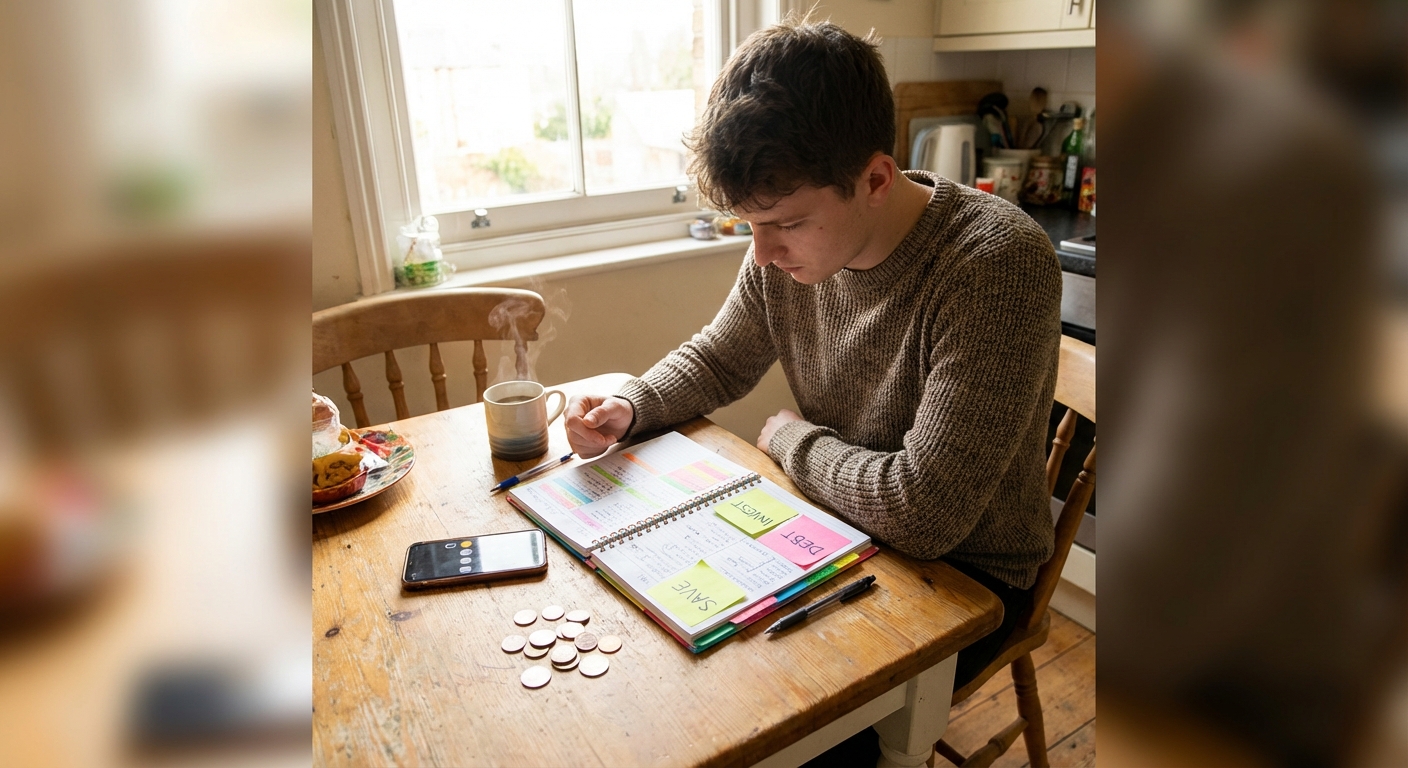
Many people try to fix their finances with a burst of willpower: a strict budget, a no-spend month, or an extreme payoff plan. A few weeks later, they’re exhausted and back where they started.
Why Mindset Habits Beat Willpower
A more sustainable approach is to build tiny, repeatable habits that gently reshape your money mindset over time. Think 2–5 minutes a day, not hours.
This article shares 7 simple daily practices designed for beginners. Each one:
- Takes only a few minutes
- Requires no special apps or tools
- Comes with clear examples and scripts
You don’t need to do all seven. Start with one or two that feel doable.
Habit 1: The 60‑Second Balance Check
Goal: Reduce fear of “not knowing” and build awareness.
Many people avoid looking at their accounts because they’re scared of what they’ll see. Unfortunately, avoiding your balance usually makes things worse—late fees, overdrafts, and surprise declines.
What to Do (1 Minute)
Once a day, at roughly the same time:
- Open your main bank app.
- Look at your checking account balance.
Ask yourself one question: "Is this enough to get me to my next payday, given my upcoming bills?"
If "no," don’t panic. Just note it. Over time, this habit:
- Makes your money feel less mysterious
- Helps you catch problems before they become emergencies
Example Script
"My checking balance is $214. My next paycheck is in 4 days. I have $80 in known bills and usually spend about $10/day on food and transport. I’m okay if I keep my spending around $15/day or less."
You don’t have to solve everything instantly. You just need awareness.
Habit 2: The “One Line a Day” Money Journal
Goal: Connect your emotions and choices around money.
You don’t need a full diary. Just one line per day can reveal patterns.
What to Do (2 Minutes)
At the end of the day, write one sentence answering:
- "What’s one money-related choice I made today, and how did it feel?"
Examples:
- "Packed lunch instead of eating out; felt proud and a bit annoyed."
- "Ignored my credit card bill email; felt anxious."
- "Transferred $10 to savings; felt calmer."
After a week or two, read back through your lines. You’ll likely notice:
- Triggers (boredom, stress, social pressure)
- Choices you feel good/bad about
- Wins you forgot to celebrate
Awareness is the foundation of a healthier mindset.
Habit 3: The $5 Future Fund
Goal: Prove to yourself that you can save, even in small amounts.
Scarcity mindset says, "I can’t save, I barely make enough." This habit gently challenges that belief.
What to Do (2–3 Minutes, When You’re Paid)
Every time you receive income:
- Move $5 into a separate savings account labeled “Future Me” or "Safety Net."
- Treat this as non-negotiable, like a small bill you pay to yourself.
If $5 feels impossible right now, start with $2. The amount matters less than the consistency.
What It Looks Like Over Time
If you’re paid weekly and save $5 each time:
- 1 month (~4 weeks): $20
- 6 months: about $120
- 1 year: about $260
This may not solve everything, but it proves that saving is possible—and that alone changes your mindset.
Habit 4: The 24‑Hour Pause on Purchases Over $40
Goal: Reduce impulse spending without banning all fun.
You don’t need to say “no” to everything. You just need space to decide.
What to Do
Create a personal rule:
"If a non-essential purchase costs more than $40, I’ll wait 24 hours before deciding."
Steps:
- See something you want (shoes, gadget, decor).
- Add it to a wishlist (notes app, screenshot folder, or store cart).
- Wait 24 hours.
The next day, ask:
- Do I still want this? - Will I use it enough to justify the cost? - Does this fit with my current goals (like paying down debt or building savings)?
If yes, buy it without guilt. If no, you just gave yourself a raise by not spending.
Example in Numbers
If you avoid just two $50 impulse buys per month using this rule:
- That’s $100/month
- Over a year, that’s $1,200 you could put toward debt or savings instead.
Habit 5: The 3‑Minute “Money Wins” Review
Goal: Train your brain to notice progress, not just problems.
Most of us only notice when things go wrong. This creates a constant sense of failure, even when we’re improving.
What to Do (3 Minutes, Once a Week)
Once a week (say, Sunday evening):
- Open your notes.
- Write down 3 money wins from the past week.
A win can be:
- Paying a bill on time
- Saying no to a purchase that didn’t align with your goals
- Asking a question about benefits at work
- Checking your bank balance instead of avoiding it
Example
This week’s wins:
- Checked my account balance 5 days in a row.
- Brought coffee from home 3 times and saved about $9.
- Paid $20 extra on my credit card.
This habit combats the belief that you’re “bad with money” and replaces it with evidence of progress.
Habit 6: The “One Term a Day” Learning Snack
Goal: Build confidence by slowly learning money language.
Confusing terms (APR, 401(k), index fund) can make you feel dumb and shut down. You’re not dumb—no one is born knowing this.
What to Do (2–3 Minutes)
Once a day, pick one finance term and look it up. Write a simple definition in your own words.
Examples:
- APR: The percentage cost per year of borrowing money on a loan or credit card.
- Minimum payment: The smallest amount you must pay on a debt each month to avoid being marked late.
- Emergency fund: Money saved for true emergencies, like job loss, medical bills, or car repairs.
Over a month, you’ll understand ~30 terms. That alone can make money feel less intimidating.
Habit 7: The Nightly “Next Day Money Intention”
Goal: Start each day with one clear, doable money action.
Instead of vague goals like “be better with money,” choose one tiny action per day.
What to Do (2 Minutes, Before Bed)
Each night, write one sentence:
"Tomorrow, my one money intention is to ____."
Examples:
- "Check my credit card balance."
- "Bring lunch instead of buying."
- "Call my internet provider and ask about a cheaper plan."
- "Transfer $10 to savings."
Keep it small enough that you’re 90% sure you’ll do it.
Example Week of Intentions
- Mon: "Look up the word ‘APR’ and write down what it means."
- Tue: "Check my paycheck and confirm taxes and deductions."
- Wed: "Move $5 to savings."
- Thu: "Review subscriptions and cancel one I don’t use."
- Fri: "Write down all my debts with balances and interest rates."
- Sat: "Spend 10 minutes watching a beginner money video."
- Sun: "List 3 money wins from this week."
By the end of the week, you’ve taken 7 concrete actions with very little stress.
How to Choose the Right Habits for You
You don’t need all 7 habits. Start with one or two from different areas:
- For awareness: 60-Second Balance Check, One Line a Day Journal
- For action: $5 Future Fund, 24-Hour Pause
- For confidence: One Term a Day, Money Wins Review
Ask yourself:
- Which habit feels least overwhelming?
- Which habit would reduce my stress the most if I kept it up for 3 months?
Start there.
Make Habits Easier With “When–Then” Formulas
To make a habit stick, pair it with something you already do.
Use this formula:
"When I [existing routine], then I will [new habit]."
Examples:
- "When I make my morning coffee, then I will do a 60-second balance check."
- "When I plug in my phone at night, then I will write my money intention for tomorrow."
- "When I get paid, then I will move $5 to my Future Fund."
You’re building habits into your day, not squeezing them in.
What Progress Really Looks Like
A healthier money mindset doesn’t mean you never feel stressed or make mistakes. It looks like:
- You check your accounts even when you’re nervous.
- You pause before big purchases instead of buying on autopilot.
- You save small amounts consistently instead of waiting for “extra” money that never comes.
- You see yourself as someone who is learning, not failing.
You don’t need huge changes overnight. You just need tiny habits that quietly work in your favor, day after day.
Today, choose one habit from this list and try it for 7 days. At the end of the week, ask:
"Do I feel even 5% more aware, calm, or in control of my money?"
If the answer is yes, keep going. That’s your money mindset shifting—one small practice at a time.