
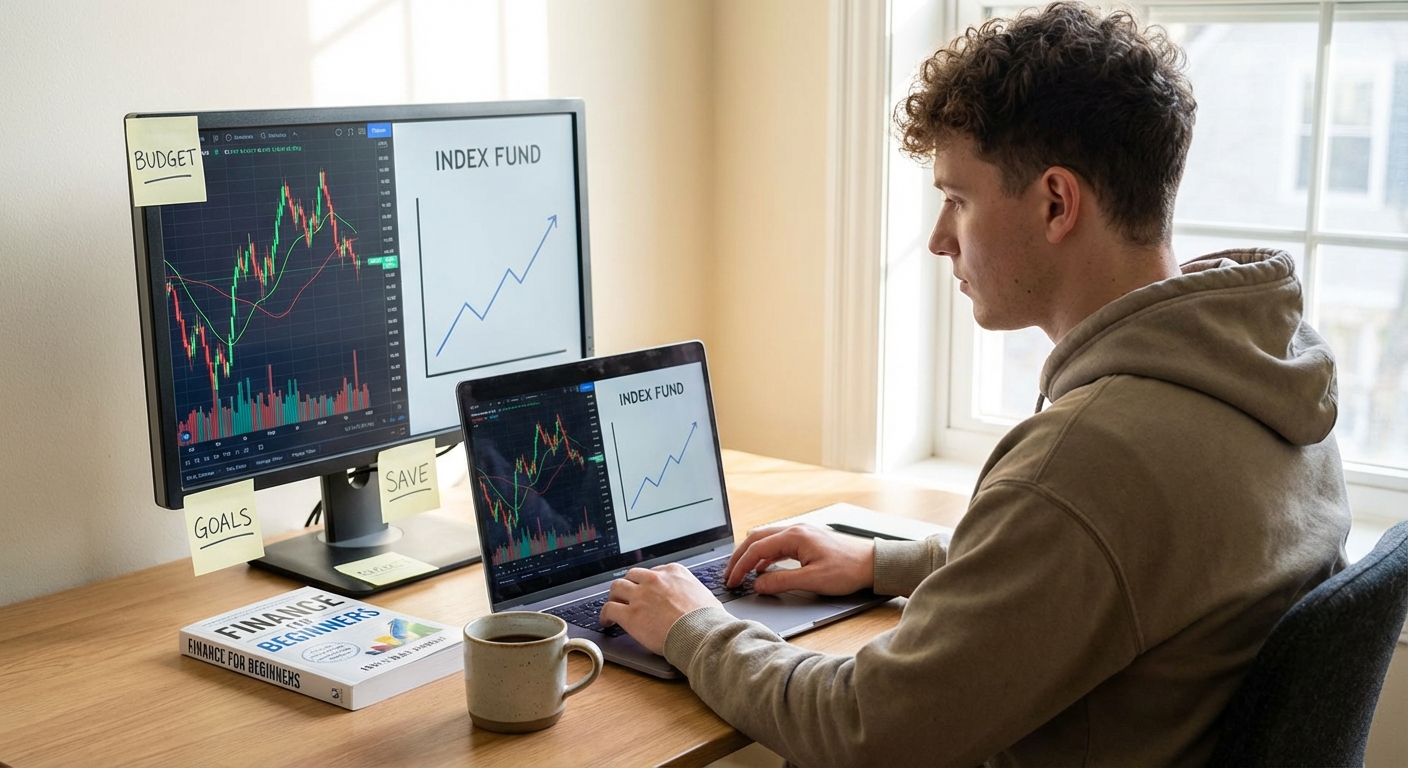
When you first start investing, you’ll hear two common paths:
The Big Question: Should You Pick Stocks or Just Buy “The Market”?
Pick individual stocks (for example, buying shares of Apple or Tesla)
Buy index funds (funds that hold many companies at once)
Both can grow your money. But they’re not equally beginner-friendly.
This guide compares index funds and individual stocks in plain language — with concrete examples — so you can choose what’s right for your first investment.
First, Clear Definitions (Without the Jargon)
What Is an Individual Stock?
An individual stock is a tiny piece of ownership in a single company.
- If you buy 1 share of Apple, you own 1 tiny piece of Apple
- Your results depend on how that one company performs
What Is an Index Fund?
An index fund is a basket of many stocks (or bonds), designed to follow a specific slice of the market.
Common examples:
- S&P 500 index fund – holds 500 large U.S. companies
- Total stock market index fund – holds thousands of U.S. companies
When you buy one share (or a fraction of a share) of an index fund, you own a little bit of every company inside that basket.
Risk: All Your Eggs in One Basket vs. Many Baskets
Individual Stocks: Focused Risk
If you put $1,000 in a single stock:
- If the company does very well, your $1,000 might grow to $1,500 or more
- If the company struggles, your $1,000 might drop to $600 — or less
Your entire result depends on one business.
Index Funds: Spread-Out Risk
If you put $1,000 in an S&P 500 index fund:
- You own pieces of 500 companies at once
- If one company does poorly, it’s a small slice of your total
- Your results depend on the overall market, not any single stock
This “spread-out” approach is called diversification. It doesn’t remove risk, but it usually reduces the impact of one company’s failure.
For beginners, this can make investing feel calmer and more predictable over the long run.
Example: $1,000 in a Single Stock vs. $1,000 in an Index Fund
Let’s say you have $1,000 to invest.
Scenario A: You Buy One Stock
You decide to invest the full $1,000 into Company X at $50 per share.
- You buy 20 shares ($1,000 ÷ $50)
After a year:
- Company X has a rough year; the stock falls to $35/share
- Your 20 shares are now worth $700 (20 × $35)
Result: -30% loss.
Scenario B: You Buy a Broad Index Fund
You invest the same $1,000 into a total market index fund.
After a year:
- Some companies in the index do poorly
- Others do well
- Overall, the index grows by 6%
Your $1,000 becomes $1,060.
Result: +6% gain.
In any given year, a single stock might beat the index, but it can also do much worse. The index fund spreads your bets.
Time and Effort: Research vs. Simplicity
Owning Individual Stocks Takes Work
To invest wisely in individual stocks, you typically need to:
- Read financial reports
- Understand the company’s business model
- Follow industry news
- Keep an eye on competitors
- Decide when to buy or sell
Some people enjoy this. Many don’t have the time or interest.
Index Funds Save Time
With an index fund, you’re not trying to guess winners.
- You buy the fund
- You hold it for many years
- You let the overall market work for you
You still need to choose which index fund, but that’s a one-time decision you revisit occasionally, not a daily task.
For most beginners juggling work, family, and life, simplicity helps you stay consistent.
Costs and Fees: Why They Matter More Than You Think
Trading Costs
Many brokers now offer $0 commissions for buying and selling both stocks and ETFs (exchange-traded funds).
So for a lot of platforms:
- Buying an individual stock: $0 fee
- Buying an index ETF: $0 fee
Check your broker or app to confirm.
Ongoing Fund Fees (Expense Ratios)
Index funds charge a small annual fee called an expense ratio.
- Example: A fund with a 0.05% expense ratio charges $0.50 per year on every $1,000 you invest
Individual stocks don’t have an expense ratio.
However, many broad index funds are so cheap that fees are usually not a reason to avoid them.
What costs more in the long run is often poor performance from trying to pick stocks and missing the market’s overall growth.
Emotions: Roller Coaster vs. Steady Ride
Individual Stocks Can Be a Wild Ride
If you own just a few stocks, your account balance might swing a lot.
- One negative news headline can send your stock down 10–20% in a day
- This can tempt you to panic sell at the worst possible time
Index Funds Often Feel Calmer
They still go up and down — especially stock-based index funds — but usually:
- Day-to-day swings are smaller than individual volatile stocks
- You’re less emotionally attached to any one company
This can make it easier to stay invested through rough patches, which is critical for long-term success.
So Which Is Better for Beginners?
While every person is different, many beginner investors find this approach helpful:
Start with index funds as your foundation
Consider adding a small portion (if you want) to individual stocks later as you learn
Think of it like this:
- Index funds = solid base of your financial house
- Individual stocks = optional decorations once the base is strong
A Simple Starter Portfolio Comparison
Let’s compare two beginners, Jordan and Sam.
Jordan: Index Fund First
- $200/month into a total stock market index fund
- Invests steadily for 10 years
- Market averages 7% per year (not guaranteed)
After 10 years:
- Jordan has contributed: $24,000
- Portfolio value: about $34,600
Jordan didn’t pick stocks, time the market, or follow daily news.
Sam: Stock Picker Without Experience
- $200/month split between 3–4 random stocks based on tips and social media
- Sells when nervous, buys when hyped
After 10 years, due to poor timing and concentrated bets:
- Sam has contributed: $24,000
- Portfolio value: maybe $20,000–$28,000 (very dependent on luck and timing)
Sam worked harder but may end up with less money.
When Might Individual Stocks Make Sense?
Individual stocks can be reasonable if:
- Your core portfolio is already built with index funds
- You understand that stocks can go to zero
- You limit them to a small portion of your total investments
Many people follow a rule like:
- At least 80–90% in index funds
- Up to 10–20% in individual stocks (if desired)
This way, you can learn and experiment without risking your entire future.
How to Choose Your First Index Fund
If you decide index funds make sense for you, here’s a simple approach.
Check your account options (401(k), IRA, brokerage)
Look for:
- A total stock market index fund or - An S&P 500 index fund
Compare:
- Expense ratio (lower is usually better; under 0.20% is common) - Whether it’s available in your current account
examples of names you might see (these are generic types, not recommendations):
- “Total Stock Market Index Fund”
- “U.S. Broad Market Index Fund”
- “S&P 500 Index Fund”
If your workplace offers a target-date fund with low fees, that can be an even simpler all-in-one choice for retirement accounts.
The Bottom Line for Beginners
- Individual stocks can be exciting, but they’re risky and time-consuming
- Index funds offer instant diversification, simplicity, and a calmer path
You don’t need to be a stock expert to start investing.
Many successful long-term investors:
- Buy broad index funds
- Invest regularly
- Ignore the noise
- Let time and compound growth do most of the work
If you’re just getting started, choosing an index fund for your first investment is a practical, beginner-friendly decision.
You can always learn more and add complexity later — but you don’t have to start there.
PennyPath Finance is here to help you build a strong investing foundation, one informed decision at a time.